

Hardly any other country in the world is as religiously diverse and spiritual as India Religion is not just a private matter or an occasional visit to church – it is deeply rooted in everyday life, in families, cities, rituals and even in the rhythm of the day. Temple bells in the morning, calls to prayer from mosques, incense sticks in front of small house altars, pilgrims on the Ganges or meditating monks in Buddhist monasteries are all part of everyday life in India.
India is considered the cradle of several world religions. Created here:
- Hinduism,
- Buddhism,
- Jainism
- and Sikhism.
At the same time, they have been living there for centuries:
- Muslims,
- Christians,
- Jews,
- Parses of Zoroastrianism,
- Bahai
- as well as numerous indigenous communities with their own natural religions.
This religious diversity continues to shape architecture, music, food, clothing, holidays and social life to this day.
What is religion actually?
Religion is a belief system that attempts to provide answers to life’s big questions:
- Where do we come from?
- Why do we exist?
- What happens after death?
- What is the right thing to do?
- Is there a higher power?
Religion usually includes:
- Prayers,
- Rituals,
- sacred places,
- moral rules,
- spiritual practices,
- Fixed
- and sacred writings.
In India, religion, philosophy and everyday life often blur together. Many people see their religion not just as a belief, but as a way of life.
Hinduism – the oldest religion in India

Hinduism is the oldest major religion in India and also the country’s largest religion. Around 80 percent of the Indian population belong to Hinduism.
Many Hindus do not refer to their religion as “Hinduism”, but as:
Sanatana Dharma
This means:
“the eternal order” or “the eternal law”.
Unlike many other religions, Hinduism does not have a single founder. It has developed over several thousand years and encompasses many different traditions and beliefs.
Important beliefs are:
- Karma,
- Rebirth,
- Dharma,
- and moksha – liberation from the cycle of rebirths.
Many Hindus worship various deities such as:
- Shiva,
- Vishnu,
- Lakshmi,
- Durga
- or Ganesha.
One of the holiest cities in Hinduism is Varanasi on the holy river Ganges. Many Hindus make a pilgrimage there to bathe in the waters of the Ganges and experience spiritual purification.
Rishikesh is considered the “world capital of yoga” and is an important spiritual center on the holy Ganges. Many people travel there for:
- Yoga,
- Meditation,
- Ashram stays
- and spiritual purification.
Haridwar is one of the seven holiest cities in Hinduism. Millions of pilgrims descend to the Ganges every year to bathe in the holy waters. The famous Kumbh Mela – one of the largest religious festivals in the world – also takes place there regularly.
Pushkar is particularly famous for the rare Brahma Temple, one of the few temples in India dedicated to the god Brahma. The sacred Pushkar Lake is considered an important place for rituals and pilgrimages.
Festivals also play an enormous role:
- Holi, the color festival,
- and Diwali, the festival of lights,
are among the most famous religious festivals in India.
Buddhism – the path to enlightenment
Buddhism originated in India in the 5th century BC.
It was founded by Siddhartha Gautama. Buddha wanted to understand why people suffer and how they can find inner peace.
The central teachings of Buddhism are:
- the Four Noble Truths,
- the Eightfold Path,
- Mindfulness,
- Meditation
- and compassion.
The most important Buddhist place in India is the Mahabodhi Temple in Bodhgaya in Bihar. Buddha is said to have attained enlightenment there under the Bodhi tree.
Sarnath near Varanasi is also significant because Buddha gave his first sermon there.
Although Buddhism originated in India, only a small proportion of the Indian population still adheres to this religion today. Around 0.7 percent of people in India are Buddhists, which corresponds to around 8 to 10 million people. Nevertheless, Buddhism has enormous historical and spiritual significance for India, as many of the world’s most important Buddhist shrines are located there.
Today, a particularly large number of Buddhists live in Maharashtra, Ladakh, Himachal Pradesh, Sikkim and Arunachal Pradesh. In the 20th century, a large Buddhist movement developed in Maharashtra through B. R. Ambedkar. Ambedkar campaigned against the Hindu caste system and converted to Buddhism along with hundreds of thousands of people. For many so-called Dalits, Buddhism thus became a way out of social oppression and discrimination.
Various forms of Buddhism are practiced in India today. Tibetan Buddhism is particularly widespread in the Himalayan regions. There are also Mahayana, Theravada and so-called Navayana traditions. Today, Tibetan Buddhism has a particularly strong influence on the regions of Dharamshala and McLeod Ganj in the north of India.
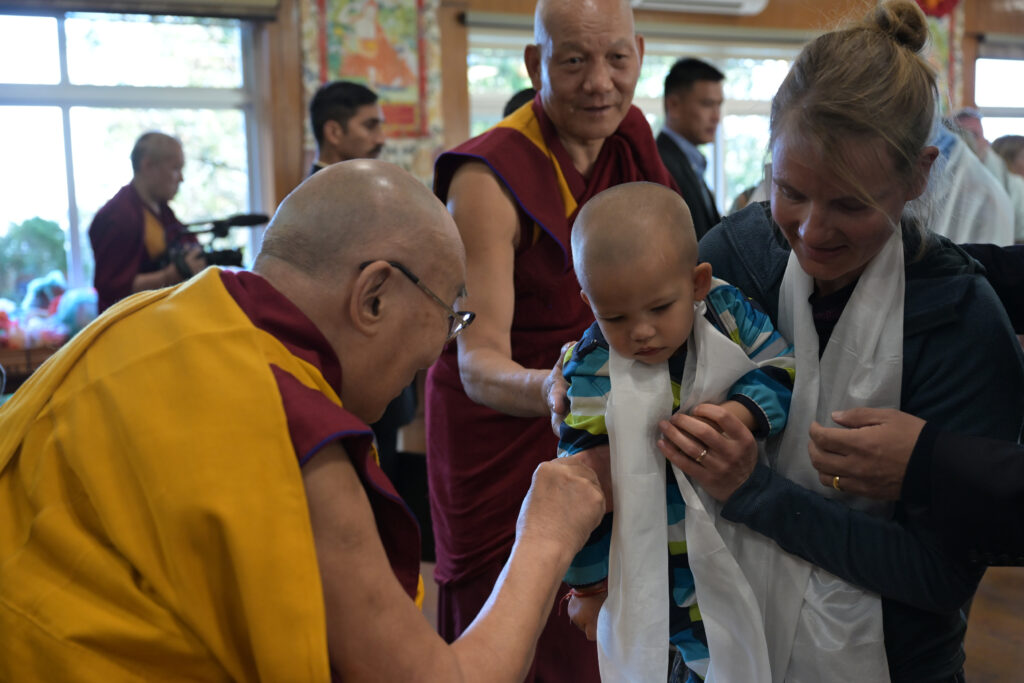
The Dalai Lama and his Tibetan government in exile in Mcleod Ganj
The Dalai Lama, the spiritual leader of Tibetan Buddhism, plays a central role in this. After Tibet was occupied by China in 1959, the Dalai Lama fled to India. The Indian government granted him asylum and since then he has been living in McLeod Ganj in the Himalayas near Dharamshala.
McLeod Ganj thus developed into the most important center of Tibetan Buddhism outside Tibet. Today, the Tibetan government-in-exile, numerous monasteries, Buddhist schools, meditation centers and libraries are located there. For Buddhists from all over the world, this place is therefore of great spiritual significance.
The Namgyal Monastery, the Dalai Lama’s personal monastery, is particularly important. Many people travel to McLeod Ganj to meditate, listen to Buddhist teachings or get to know Tibetan culture.
The atmosphere of the place is strongly influenced by Buddhism. Prayer flags, prayer wheels, temples, monks in red robes and small incense altars can be seen everywhere. Meditation, compassion and mindfulness characterize the everyday lives of many people there. At the same time, Tibetan refugees are still trying to preserve their religion, language and culture in exile.
As a result, McLeod Ganj has not only become a political center of the Tibetan community, but also a world-famous spiritual place for Buddhists and spiritually interested people from all over the world.
The Tushita Center in Mcleod Ganj offers intensive ten-day silent retreats “Introduction to Buddhism”, which I can highly recommend. But the daily Dropp In meditations from 9 to 10 a.m. are also worthwhile.
Jainism – non-violence as a life principle

Jainism is one of the oldest religions in India. It was created in the 6th century BC. A central personality is Mahavira.
The most important idea of Jainism is:
Ahimsa – absolute non-violence.
Jainas try not to harm any living being. That’s why many people are strictly vegetarian or vegan. Some even wear a scarf over their mouths so that they don’t inhale any small insects, only eat in daylight and sweep the sidewalk in front of them.
In everyday life, religion means:
- Discipline,
- Self-control,
- Meditation,
- Fasting
- and respect for all life.
Important pilgrimage sites of Jainism are:
- Palitana Temples
- and Shravanabelagola.
The huge statue of Saint Bahubali in Shravanabelagola is particularly impressive. But you can also admire Jain temples in many Rajasthani cities, with the Ranakpur temple in Jaipur standing out in particular.
Jain restaurants can be found all over India. Here, the food is cooked without food that grows underground.
Sikhism – equality and community

Sikhism originated in the 15th century in Punjab in northern India and, like Jainism and Buddhism, is also a reflection of Hinduism.
Its founder was Guru Nanak, who criticized social inequality and the caste system.
Sikhism teaches:
- Equality of all people,
- Honesty,
- Helpfulness
- and community.
Sikhs believe in a single God. The scripture reads:
Guru Granth Sahib.
The most important shrine of the Sikhs is the Golden Temple.
The temple has four entrances – as a symbol that people of all religions are welcome.
Particularly famous there is the:
Langar
This is a free community kitchen where thousands of people can eat for free every day – regardless of religion or origin.
Many Sikhs wear:
- Turban,
- Beard,
- and long hair.
These external signs symbolize dignity and faith.
Islam in India

Islam came to India through traders as early as the 7th century. Later, Muslim sultanates and the Mughal rulers shaped large parts of the country.
Today, over 200 million Muslims live in India (approx. 15 % of the total population) – making India one of the countries with the largest Muslim population in the world.
Important Islamic places are:
- Jama Masjid in Old Delhi
- Ajmer Sharif Dargah
- and the Taj Mahal in Agra
Sufism in particular, a mystical form of Islam, plays an important role in India.
Christianity in India

Christianity has existed in India for a very long time. According to tradition, the apostle Thomas brought the Christian faith to India as early as the 1st century.
Many Christians live today:
- in Kerala,
- Goa
- and in the northeast of India.
Important Christian places are:
- Basilica of Bom Jesus
- and Velankanni Church.
Many Christian communities operate:
- Schools,
- Hospitals
- and social institutions.
If you are in India over Christmas or Easter, you can spend these holidays in Goa or Kerala.
It is interesting to note that Christianity has a Hindu influence. Shoes are taken off in churches and a temple pillar is often found in front of large churches.
Natural religions and indigenous communities

In addition to the major world religions such as Hinduism, Islam, Buddhism and Christianity, there are also numerous indigenous religions and spiritual traditions in India. The members of these communities are often referred to as “Adivasi” in India. The word roughly translates as “first inhabitants” and describes the original population groups of the Indian subcontinent. Today, over 100 million people in India belong to such indigenous communities. This corresponds to around 8 to 9 percent of the population. This means that India has one of the largest indigenous populations in the world.
Many indigenous communities live in central India and in remote mountain and forest regions. A particularly large number of Adivasis live in the states of Jharkhand, Chhattisgarh, Odisha, Madhya Pradesh and in the north-east of India in Nagaland, Meghalaya and Mizoram. The best-known groups include the Santhal, Gond, Bhil, Khasi, Naga and Mizo. Each of these communities has its own traditions, languages, rituals and spiritual beliefs.
Our Odhisha bike tour offers very special insights into the traditional life of the Adivasi.
The religions of many indigenous groups are often referred to as natural religions. Nature is at the center of the spiritual life. Many communities believe that rivers, mountains, forests, animals or certain places have spiritual powers. Ancestral spirits and guardian spirits often also play an important role. For many indigenous people, nature is not just an environment, but something sacred and alive.
This is why many villages have sacred forests, special trees or spiritual places where rituals are performed. Unlike in many world religions, there are often no holy books. Knowledge, stories and religious traditions are usually passed on orally from generation to generation.
Music, dance and rituals have great spiritual significance in many indigenous communities. Religious festivals are often based on the seasons, the harvest or natural cycles. Drumming, singing, fire ceremonies and traditional dances are often part of religious celebrations. Many rituals should:
- bring protection,
- ensure good harvests,
- Cure diseases
- or strengthen the connection to ancestors.
Community, family and nature are closely linked in everyday life. Many indigenous groups traditionally lived from agriculture, hunting or forestry. Medicinal plants, natural knowledge and traditional medicine are still very important today.
Throughout history, many indigenous communities have been partly influenced by Hinduism. Some adopted Hindu deities or holidays. Nevertheless, many groups preserved their own spiritual traditions. This is why indigenous natural religions are often mixed with elements of Hinduism today. In northeast India, many indigenous groups were later influenced by Christianity.
Today, many indigenous communities are facing major challenges. Due to deforestation, mining, industrial projects or dams, many people are losing their land, their forests and often also their spiritual places and cultural traditions. Many indigenous groups are therefore fighting to protect their habitats and their cultural identity.
The nature religions of the Adivasi show a special spiritual view in which man and nature are closely connected. Especially in times of environmental destruction and climate change, many of these ideas are once again gaining importance.
The Hornbill Festival in Nagaland
A particularly fascinating expression of the indigenous cultures of North East India is the famous Hornbill Festival in Nagaland. The festival takes place every year at the beginning of December near the capital Kohima and is considered one of the most important cultural festivals in India. It was named after the hornbill, the hornbill that has spiritual and cultural significance for many Naga tribes.

During the festival, numerous indigenous Naga tribes come together to:
- traditional dances,
- Music,
- Rituals,
- Clothing,
- Craftsmanship
- and their spiritual traditions.
The festival impressively demonstrates the enormous cultural diversity of North East India. Many of the communities living there still have strong indigenous roots and preserve traditional beliefs, closeness to nature and tribal cultures. At the same time today:
- Christianity,
- Buddhist influences,
- indigenous natural religions
- and modern lifestyles
on top of each other.
If you want to experience this special region intensively, you can do so on two special tours from Chalo Reisen.
The Hornbill Festival Tour to North East India takes 16 days through Nagaland and Arunachal Pradesh to the border with Myanmar. The trip enables encounters with over ten different indigenous groups and connects people:
- Tribal cultures,
- Buddhist monasteries,
- remote mountain regions,
- traditional villages
- and the Hornbill Festival itself.
The three-week special trip by bike to the Hornbill Festival is also particularly intense. A cycle tour lasting several days leads from Shillong to Kohima through the remote landscapes of north-eastern India. Overnight stays are sometimes in homestays or tents, which enables real encounters with the people of the region. The participants then experience the cultural rituals, dances and festivities of the Hornbill Festival for several days.
These trips not only provide tourist impressions, but also deep insights into the spiritual, cultural and ethnic diversity of a part of India that is still largely unknown to many travelers.
Religion and politics – Modi and the BJP
Religion also plays an important political role in India.
Narendra Modi belongs to the BJP, the Bharatiya Janata Party.
The BJP represents a strongly Hindu nationalism. Critics accuse the party of discriminating against religious minorities – especially Muslims.
At the same time, Modi is popular with many people because he:
- economic development,
- Infrastructure,
- Digitization
- and national strength.
India officially sees itself as a secular state. This means:
- all religions should be treated equally,
- and religious freedom is protected by law.
In reality, however, the interplay between religion and politics remains a sensitive issue.
Pilgrimage in India – spiritual journeys between temples, ashrams and holy rivers

Pilgrimage means traveling to a holy place for religious or spiritual reasons. The goal of a pilgrimage is often:
- spiritual cleansing,
- inner development,
- Gratitude,
- or the search for knowledge and peace.
In India, pilgrimage has been of enormous importance for thousands of years. Millions of people travel every year:
- to Varanasi,
- Rishikesh,
- Bodh Gaya,
- Amritsar
- or Haridwar.
However, pilgrimage in India often means more than just visiting holy places. It’s about:
- Encounters,
- Rituals,
- Meditation,
- Prayers,
- and the conscious experience of spiritual traditions.
Our three-week yoga pilgrimage through northern India offers a particularly intensive opportunity to experience this spiritual diversity for yourself. The journey leads to important spiritual places of different religions and connects them:
- Pilgrimage sites,
- Yoga,
- Meditation,
- Ashram stays
- and cultural encounters with each other.
The participants visit:
- Rishikesh on the holy Ganges,
- Varanasi,
- Amritsar,
- Mcleod Ganj,
- Pushkar,
- Old Delhi,
- Agra
The stays at the ashram in Rishikesh and the Sri Jasnath Ashram in Rajasthan during the trip in particular provide deep insights into everyday spiritual life in India. There travelers experience:
- Meditation in the morning,
- community life,
- Yoga lessons,
- spiritual ceremonies,
- Vegetarian diet
- and traditional rituals directly on site.
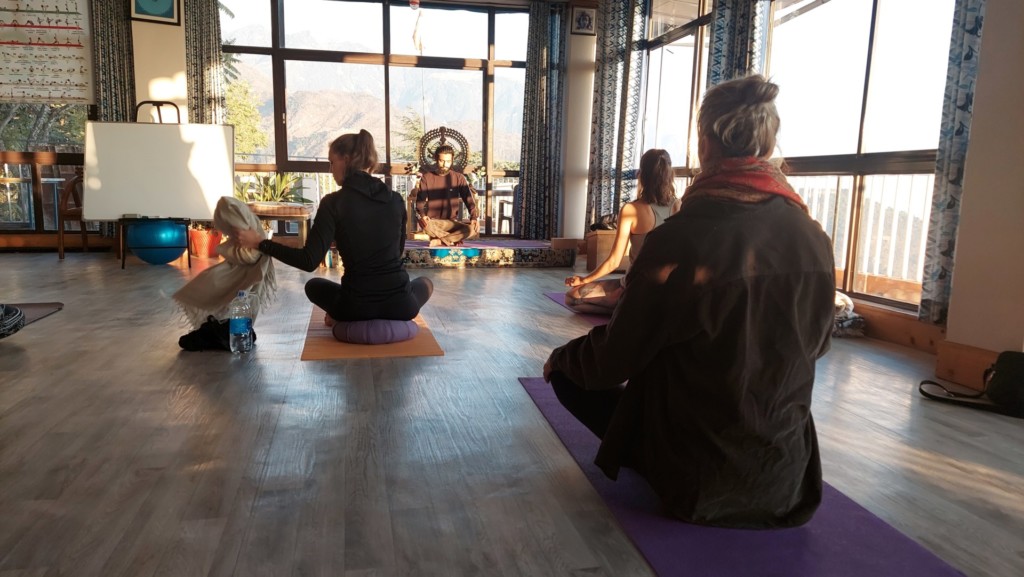
Yoga is not only understood as a physical practice, but also as part of a spiritual tradition in India that is thousands of years old. The trip therefore combines movement, spirituality, culture and encounters in a special way.
What’s special: This trip is accompanied by a German-speaking yoga teacher with daily yoga classes during the trip.